The Utah DMV says no notary is needed to sign off on a title. Here is the state's own wording, what three Utah title forms print at the signature line, and the cases where a notary can still come up in a vehicle sale.
No. The Utah DMV says in plain words that no notary is needed to sign off on a title. A notary comes up in a Utah vehicle sale when some other paper in the deal has its own notary block, such as a title issued by another state or a form from a lender.
Key Takeaways
- The Utah DMV's buyer and seller page says: "No notary is needed to sign off on a title."
- Utah Code 41-1a-702 has the owner endorse the title "in the space for assignment and warranty of title." The words notary and notarized do not appear in that section.
- Three state forms opened for this article, the Bill of Sale (TC-843), the duplicate title application (TC-123) and the Odometer Disclosure Statement (TC-891), have no notary wording in their text.
- If a title from another state or a paper from a lender or insurer has a notary block printed by the signature, leave that signature blank and bring it to a notary with your ID.
- NotaryLTD charges $10 per notarial act in person and $25 per act by remote online notarization, plus an agreed travel fee for mobile visits.
Does a Utah car title need to be notarized?
No, according to the Utah DMV. Its page on the responsibilities of buyer and seller says "No notary is needed to sign off on a title." The seller signs the title to release ownership.
That sentence is on the Utah DMV page on the responsibilities of buyer and seller, under the heading about getting a negotiable title from the seller, as opened on November 23, 2026. Ten Utah DMV pages on titles and sales were opened for this article. That sentence is the only place any of them mentions a notary.
So before you book a notary for a Utah title, stop. For an ordinary private sale of a vehicle with a Utah title, the state's own instructions do not send you to one. If someone in the deal insists on a notary, ask them what exactly they want notarized and why. The rest of this article covers the cases where that request has something behind it.
What does Utah law say about signing over a title?
Utah Code 41-1a-702 says the owner transfers a vehicle by endorsing the certificate of title "in the space for assignment and warranty of title." The section does not mention a notary. It also sets out when every co-owner has to sign.
The section is short. You can read it at Utah Code 41-1a-702. The version opened is marked effective May 10, 2016. The words notary, notarized and acknowledged do not appear anywhere in it.
On co-owners, the section says that when owners are joined by "or" or "and/or," each owner can endorse the title alone, and when they are joined by "and," each co-owner's endorsement is required. The DMV gives the same rule with an example: "If the title says, 'John Doe and Jane Doe,' both must sign off on the title." Count your signers from the front of the title before you meet the buyer.
Which Utah title forms have a notary block?
None of the three Utah forms opened for this article has notary wording. The Bill of Sale, the duplicate title application and the Odometer Disclosure Statement each end with the signer's own certification and a signature line. Three other forms could not be opened and are listed below.
Each form was opened on November 23, 2026. Each form was read as text and checked for notary wording, an oath, a seal area or a perjury statement. Forms are revised, so read the copy you are actually signing.
| State document opened | Revision | What is printed at the signature | Notary wording? |
|---|---|---|---|
| Bill of Sale, form TC-843 | Not shown in the text read | Seller: "I hereby transfer all my rights, title and interest to this vehicle to the new owner, named below." Buyer: "I certify, to the best of my knowledge, that the above information is correct." | None |
| Application for Utah Duplicate Title, form TC-123 | Rev. 4/26 | Owner: a certification that begins "I certify that this vehicle's original title has been lost, stolen, mutilated, or made illegible". There is also a line for the "Signature of lien holder (releasing interest)" | None |
| Odometer Disclosure Statement, form TC-891 | Rev. 6/26 | "I certify that the odometer reading is (check one):" followed by the transferor's and transferee's signatures | None |
| Publication 9, How to Register and Title your Vehicle in Utah | Rev. 01/26 | Not a form. It tells a seller: "Give the new owner the signed title and a bill of sale." | None |
Not opened: the Application for Utah Title (TC-656), the Ownership Statement (TC-569A) and the Survivorship Affidavit (TC-569C). The DMV names them on its pages for transfers without a title and for deceased owners, and those pages do not mention a notary. The forms themselves could not be read for this article, so nothing is said here about their signature blocks. If you are filling one out, read the area around the signature line the same way as the table above.
Does a Utah bill of sale need to be notarized?
The Utah DMV does not ask for it. The DMV lists what a bill of sale should contain, including the "name, address and signature of the seller," and offers its own form TC-843, which has no notary wording.
The same DMV page says a bill of sale "can be handwritten or typed/printed, but it should be in ink, not pencil," and adds: "If desired, you can use the TC-843, Bill of Sale provided by the DMV." Nothing on that page or on the form asks for a notary.
A buyer, a lender or an agency in another state may still ask for a notarized bill of sale for its own reasons. That is their requirement, not something the Utah DMV pages opened for this article state. If you get that request, see the section below on having a paper notarized anyway.
What if the title is from another state and has a notary block?
Read the title itself. The Utah DMV tells buyers to make sure the seller of a vehicle with an out-of-state title "has signed where necessary to release their ownership." If a notary block is printed by that signature, leave it unsigned and ask before anyone signs.
That wording is on the Utah DMV page for transferring an out-of-state title. The page does not mention a notary and does not say what the DMV does with a title that has an empty notary block. Each state prints its own title, and this article did not open any other state's rules. The two offices that can answer are the motor vehicle agency of the state that issued the title and the Utah DMV. Ask one of them before the seller signs, because a signature made outside a notary's presence may not fit the certificate printed on the page.
A Utah notary can perform an acknowledgment, a jurat or a signature witnessing on a paper that calls for one. What the notary certifies is your identity and your signature or acknowledgment, not the sale. See can a Utah notary notarize a California document for more on papers headed to another state.
When does a notary still come up in a Utah vehicle sale?
When a paper in the deal has a notary block of its own, or when someone who will receive a paper asks for it to be notarized. The title issued by Utah is not one of those papers. Use the table below to sort what you have.
This table describes what is on the page and who to ask. It does not tell you what your sale requires.
| What you are holding | What the state sources opened say | What to do |
|---|---|---|
| A Utah title, private sale | DMV: "No notary is needed to sign off on a title." | Sign where the title tells the seller to sign. No notary appointment needed |
| A Utah bill of sale or form TC-843 | DMV lists the seller's signature. No notary wording on TC-843 | Sign in ink. Go to a notary only if the person receiving it asks, and ask them which notarial act |
| A lost Utah title, form TC-123 | DMV: the form "requires the seller to sign in two places." No notary wording on the form | Sign both parts. No notary block to complete |
| A title issued by another state with a notary block by the signature | Utah DMV: the seller signs "where necessary to release their ownership." Nothing about the notary block | Leave it unsigned. Ask the issuing state's agency or the Utah DMV, then bring it to a notary with ID if they say the block is to be completed |
| A title that shows a lien holder | DMV: "If the title shows a lien holder, verify that the lien has been released." | The release comes from the lender. If the lender's own form has a notary block, that block is for the lender's signer |
| A power of attorney, affidavit or statement from a lender, insurer, court or another state | Not covered by the Utah DMV pages opened, beyond a leasing company's power of attorney for a leased vehicle | Look for "subscribed and sworn to before me" or "personally appeared." If it is there, leave the signature blank and bring it to a notary |
| A deceased owner's vehicle | DMV: you "will either use a TC-569C, Survivorship Affidavit or formal Court Documents." | Read the signature area of the affidavit you are given. That form was not opened for this article |
Can I get a title or bill of sale notarized anyway?
A notary does not stamp a document on request. A notary performs a specific notarial act and completes a certificate for it. A Utah title has no certificate printed on it, so first ask whoever wants the notarization which act they want.
The acts are defined in Utah Code 46-1-2. In an acknowledgment the notary certifies that the signer "has admitted, in the presence of the notary, to voluntarily signing a document for the document's stated purpose." In a jurat the notary certifies "that the signer affirms or swears an oath attesting to the truthfulness of a document" and "that the signer voluntarily signs the document in the presence of the notary." In a signature witnessing the signer appears before the notary, proves identity and signs the document in the notary's presence.
The notary cannot pick among those for you. Utah Code 46-1-11(1) says "A nonattorney notary may not provide advice or counsel to another person concerning legal documents." Once you know the act, the notary will perform it. Utah Code 46-1-8(2) says "A notary shall perform notarial acts in lawful transactions for any requesting person who tenders the appropriate fee specified in Section 46-1-12." More on this in what to do when a document has no notary wording and the difference between a jurat and an acknowledgment.
One caution about the title itself. A certificate of title is the state's document, and this article found no Utah source that says what the DMV does with a title carrying an added notary stamp or attached certificate. Ask the DMV before anything is added to a title. A bill of sale or a separate statement is a different paper. If one of those is what the other side wants notarized, ask them to say so.
What ID do I need if a vehicle document does need a notary?
Unexpired government identification that includes your photograph, signature and physical description, or an unexpired passport from any nation. A Utah driving privilege card is not accepted. Each person whose signature is notarized brings their own.
Utah Code 46-1-2 defines satisfactory evidence of identity as "unexpired personal identification" that "includes the individual's photograph, signature, and physical description" and is issued by the United States government, a state, a federally recognized tribal government or a foreign government, or "an unexpired passport issued by any nation." The definition excludes "a driving privilege card." Compare the name on your ID with the owner name printed on the title before you book. Details are in what ID a Utah notary accepts.
Can a vehicle document be notarized online in Utah?
Utah law allows a commissioned remote notary located in Utah to notarize over live video, and NotaryLTD offers it at $25 per notarial act. Ask the agency or company that will receive the paper whether it accepts a remotely notarized document first.
Utah Code 46-1-3.6(1) allows a remote notarization "if the remote notary is physically located in this state." Subsection (4) says "a remote notarization lawfully performed under this chapter satisfies any provision of state law" that requires an individual to personally appear before a notary. That is a statement about Utah law. Another state's motor vehicle agency sets its own rules for a title it issued, and an original paper title is a paper document. Ask before you choose this. To set up a session, start at remote online notarization.
What does it cost to notarize a vehicle document at NotaryLTD?
NotaryLTD charges $10 per notarial act in person and $25 per notarial act by remote online notarization. A mobile visit adds a travel fee based on the IRS mileage rate, agreed before the appointment. A Utah title that needs no notary costs nothing.
Utah Code 46-1-12(1)(a) sets the most a notary may charge: "for an acknowledgment, $10 per signature" and "for a jurat, $10 per signature." For a remote notarization the maximum is $25. Subsection (2) allows a travel fee "not to exceed the approved federal mileage rate" only if the notary explains that it is separate from the notarial fee and the two sides "agree upon the travel fee in advance."
| Line | How to count it | In person | Remote online |
|---|---|---|---|
| Utah title, TC-843, TC-123, TC-891 | No notary wording on the forms opened. Count zero | $0 | $0 |
| Notarized signatures | One for each person signing each paper that has a notary block or that the receiving party asked to have notarized | $10 each | $25 each |
| Travel | Mobile visits only. Quoted and agreed when you book | Based on the IRS mileage rate | None |
| Office visit in Park City | You come to 1090 Center Dr, Suite 23 | No travel fee | Not applicable |
A worked example, counted at the Utah maximum: two co-owners joined by "and" each sign one statement that has a jurat. That is two notarized signatures, or $20 in person before any travel fee. NotaryLTD confirms your total when you book. The full fee list is on the pricing page.
What should I bring, and how do I book?
Bring the complete, unsigned paper that has the notary block and unexpired government photo ID for each signer. To book, call or text 435-565-1333 with the kind of paper, the number of signers and where you want to meet.
A checklist you can copy:
- The paper with the notary block, complete and unsigned. For a title from another state, the answer you got from that state's agency or the Utah DMV.
- Unexpired government photo ID for each person signing. Check that the name matches the owner name on the title.
- Every owner who has to sign. If the title joins the owners with "and," that is all of them.
- The name of the notarial act, if the paper has no notary wording and someone asked you to notarize it.
- Any instructions from the buyer, lender, insurer or agency that will receive the paper.
NotaryLTD meets you at the Park City office at 1090 Center Dr, Suite 23, Park City, UT 84098, or at your home, office or another agreed place in Summit, Wasatch and Salt Lake counties. Appointments run Monday through Sunday, 9:00 AM to 9:00 PM, and same-day times are available.
- Contact NotaryLTD with the document type and the number of signatures. NotaryLTD confirms whether the office, a mobile visit or a remote session fits.
- Have your documents ready and unsigned.
- Present your ID.
- Sign in the notary's presence. The notary completes each certificate and applies the seal.
Not sure whether your paper has a notary block? Send a description and the page count through the contact form and ask before you drive anywhere. If buyer and seller want to sign where the vehicle is, see the mobile notary page. Service details are on the general notarization page, and the office is covered on the Park City service page.
Holding a vehicle paper with a notary block?
Call or text NotaryLTD at 435-565-1333 to book an office or mobile appointment. $10 per notarial act in person. Open Monday through Sunday, 9:00 AM to 9:00 PM.
Call 435-565-1333This article is general information about Utah notarial acts and about Utah DMV pages, state forms and statutes as they read on November 23, 2026. It is not legal advice. A notary is not an attorney and cannot tell you which papers your vehicle sale requires. Ask the Utah DMV, the agency that issued the title or an attorney.
Frequently Asked Questions
About the Author
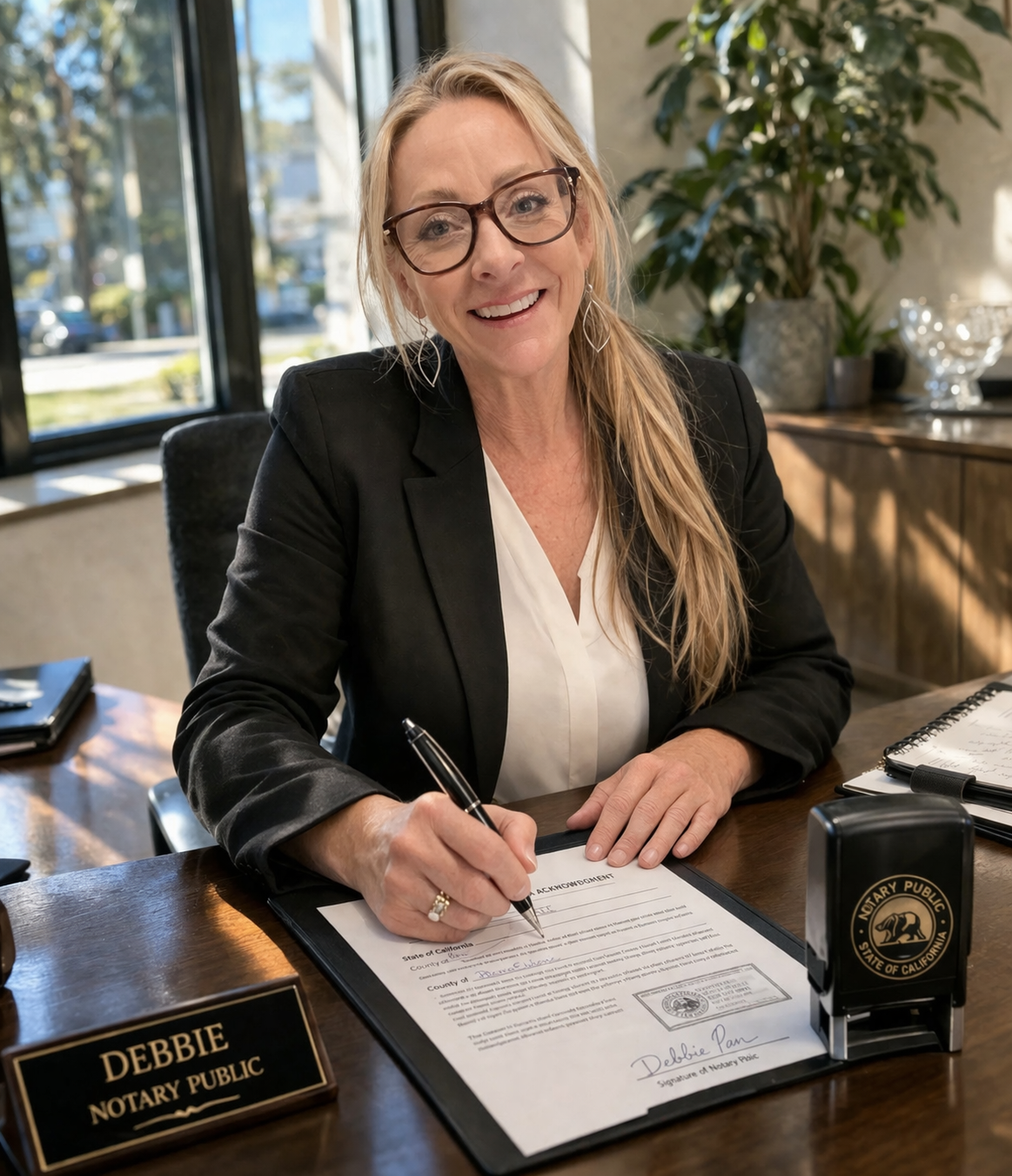
Deborah Cuha
Licensed Utah Notary Public (Commission #742886) with 30+ years of experience. NNA Certified Loan Signing Agent and Certified Remote Signing Agent. Based in Park City, serving Summit, Wasatch, and Salt Lake counties.
Read Full Bio →