The parent who is not traveling signs the letter in front of a notary and shows ID. Here is what USA.gov and the State Department say about the letter, what Utah law has the notary do, and what it costs at NotaryLTD.
The parent who is not traveling signs the consent letter in front of a notary and shows unexpired government photo ID. At NotaryLTD that is $10 per notarized signature in person. Before you book, ask the embassy of the country your child will visit what it wants the letter to say.
Key Takeaways
- The U.S. State Department says the United States "does not require evidence of both parents' permission for a minor to travel internationally" and that some countries do.
- USA.gov says: "It is preferred that the letter of consent is in English and notarized."
- USA.gov says a child traveling with one custodial parent carries a letter from the other parent, and a child traveling with a guardian or alone carries a letter both parents sign.
- Every parent whose signature is notarized has to be in the notary's presence with ID. A Utah notary cannot notarize for a parent who is not there.
- NotaryLTD charges $10 per notarial act in person and $25 per act by remote online notarization, plus an agreed travel fee for mobile visits.
Does a child travel consent form have to be notarized?
The United States does not require the letter. The State Department says some countries do, and some of those ask for it to be notarized. USA.gov says a notarized letter in English is preferred. The country your child is visiting decides, so ask its embassy.
Two federal pages were opened for this article on November 26, 2026. Here is what each one says in its own words.
The State Department's page on travel with minors says the United States "does not require evidence of both parents' permission for a minor to travel internationally" and then adds "but some countries do." It goes on: "In some countries, if you travel alone with your child, you may need a signed and notarized letter from the other parent." For a child traveling alone or with someone who is not a parent or legal guardian, it says "some countries require that parents or legal guardians provide a notarized, written permission letter."
The USA.gov page on international travel documents for children, marked last updated April 9, 2026, says: "If your child is traveling alone or with only one parent or legal guardian, they may need a letter of consent." Its next sentence is the one most people are looking for: "It is preferred that the letter of consent is in English and notarized."
Notice the words. "May need." "Preferred." "Some countries." Neither page says a U.S. agency will turn a child away without the letter, and neither page lists which countries ask for it. USA.gov tells parents to contact the embassy or consulate of the country the child will visit and "ask about letters of consent and other entry and exit requirements for that country."
Who signs the consent letter?
USA.gov gives two cases. If the child travels with one custodial parent, "the letter should be from the other parent." If the child travels with a guardian or alone, "both parents should sign the letter." Each signature that is notarized is counted and paid for separately.
The table sorts the common trips. The second column is USA.gov's wording. The last two columns are how the count works at NotaryLTD. It describes what the federal page says. It does not tell you what your trip requires.
| Who the child is traveling with | Who signs, in USA.gov's words | Notarized signatures on one letter | In person at NotaryLTD |
|---|---|---|---|
| One parent | "the letter should be from the other parent" | 1 | $10 |
| A grandparent, relative, coach or other adult | "both parents should sign the letter" (the page's wording is "with a guardian or alone") | 2 | $20 |
| Alone | "both parents should sign the letter" | 2 | $20 |
| Both parents | The page does not mention a letter for this case | 0 | $0 |
| One parent who has sole legal custody | Not covered by USA.gov. The State Department says some countries ask for the other parent's letter "or you must provide proof of sole legal custody" | Ask the embassy | Depends on the answer |
The dollar figures are the count multiplied by $10 per notarial act, before any travel fee for a mobile visit.
What should the letter say?
USA.gov gives one sentence: "I acknowledge that my child is traveling outside the country with [the name of the adult] with my permission." Anything more comes from the embassy, the airline or your attorney. A nonattorney notary cannot draft it or advise on its contents.
That limit is in Utah law. Utah Code 46-1-11(1) bars a notary who is not an attorney from giving advice or counsel about legal documents. So the notary will not tell you whether to add travel dates, passport numbers, flight details or a medical consent paragraph. Form sellers and embassies each have their own lists, and the two federal pages opened here do not give one.
What you can do is ask the people who will read the letter. A list you can copy for that call or email:
- Does my child need a consent letter to enter or leave the country, and does it have to be notarized?
- Who has to sign it: the parent who is staying home, or both parents?
- What details must it contain, and is there an official form?
- Does it have to be in another language as well as English?
- Do you accept a letter notarized online over live video, or only one signed on paper in front of a notary?
- Does it need an apostille or any other certification on top of the notarization?
- How old can the letter be on the day of travel, and does one letter cover more than one trip?
- What else should the adult carry? The State Department says: "Always bring a copy of each child's birth certificate or other evidence of your legal relationship to each child."
Ask the airline or cruise line the same questions about its own rules. Bring the answers, and the finished letter, to the appointment.
Which notarial act goes on a travel consent letter?
Whichever one is printed on the letter or named by the embassy or airline. A form may carry an acknowledgment or a jurat. If yours has no notary wording at all, ask the receiving party which act it wants. The notary cannot choose for you.
Utah Code 46-1-2 defines both. In an acknowledgment the notary certifies that the signer "has admitted, in the presence of the notary, to voluntarily signing a document for the document's stated purpose." In a jurat the notary certifies that "the signer affirms or swears an oath attesting to the truthfulness of a document" and that the signer signs in the notary's presence. For a jurat, Utah Code 46-1-6.5(2)(a) gives the question the notary asks you out loud: "Do you swear or affirm under penalty of perjury that the statements in your document are true?"
The practical difference for a parent: if the block under your signature line says "subscribed and sworn to," do not sign the letter before the appointment. If you are not sure which block you have, leave the signature blank. See the difference between a jurat and an acknowledgment and what to do when a document has no notary wording.
In either act, what the notary certifies is who signed and that the signer acknowledged or swore to the document. The certificate does not say that the signer is the child's parent, that the signer has custody, or that any country will accept the letter.
Does the parent who is not traveling have to see the notary in person?
Yes, in the sense that matters. Every person whose signature is notarized has to be in the notary's presence, either in the same room or on a live remote session. The traveling parent cannot bring a letter the other parent already signed at home and have it notarized.
Utah Code 46-1-6(2)(b) bars a notary from performing the act when the individual it is performed for is not in the notary's presence. Utah Code 46-1-2 defines that presence as being physically close enough to see and hear, or a remote connection by sight and sound. The parent who has to sign is the one who is not packing, so plan the appointment around that parent's schedule.
If the parent who is staying home cannot get to the Park City office, a mobile notary visit goes to a home or workplace in Summit, Wasatch or Salt Lake county.
Can the other parent sign online from somewhere else?
Utah law allows a remote notarization over live video when the remote notary is in Utah, and NotaryLTD offers it at $25 per notarial act. Ask the embassy or airline first whether it accepts a letter notarized that way.
Utah Code 46-1-2 defines a remote notarization as a notarial act performed "for an individual who is not in the physical presence of the remote notary." Utah Code 46-1-3.6(1) allows it "if the remote notary is physically located in this state." For a remote session the definition of satisfactory evidence of identity adds a second identity check on top of the ID, and Utah Code 46-1-6.5(6) has the certificate state that the notarization was performed remotely.
That last point is why you ask first. A border officer or airline agent in another country will be looking at a letter whose certificate says it was notarized remotely, and Utah law does not decide what they accept. If the answer is that they want ink on paper, the parent signs in person. For signers outside Utah, read can a Utah notary perform remote notarization for out-of-state signers, then start at remote online notarization.
What if I have sole custody or the other parent cannot sign?
The State Department says some countries accept "proof of sole legal custody" in place of the other parent's letter. Which papers count as proof is a question for that country's embassy or an attorney. A notary cannot answer it and cannot notarize for a parent who does not appear.
The full sentence on the State Department page is that you "may need a signed and notarized letter from the other parent" or "you must provide proof of sole legal custody." Neither federal page opened for this article says what to carry when a parent has died, cannot be found or will not sign. Those are legal questions. What the notary can do is narrow: notarize the signature of a parent or guardian who is present with ID, on a document that person brings. If a court order is part of what you carry, ask the court that issued it about certified copies.
Do I need a notarized letter for a flight inside the United States?
The two federal pages opened for this article are about international travel and say nothing about domestic flights. Airlines set their own rules for children flying alone or with another adult. Ask your airline, and get a letter notarized only if it asks for that.
No airline policy was opened for this article, so none is described here. If an airline, a cruise line, a camp or a tour operator gives you its own consent form, read the area under the signature line. A notary block there means the signature gets notarized. No block and no instruction means the form is asking for a plain signature.
What ID do the parents need, and does the child come?
Each signing parent brings unexpired government identification with a photograph, signature and physical description, or an unexpired passport from any nation. A Utah driving privilege card is not accepted. The notarial act is for the people who sign, which on most letters is the parents only.
Utah Code 46-1-2 lists what counts as satisfactory evidence of identity: unexpired personal identification that includes the individual's photograph, signature and physical description, issued by the United States government, a state, a federally recognized tribal government or a foreign government, or an unexpired passport issued by any nation. The definition excludes "a driving privilege card under Subsection 53-3-207(12)." A foreign passport is on the list, which matters for families with a parent who is a citizen of another country. More detail is in what ID a Utah notary accepts.
Check that the name on the parent's ID matches the name typed on the letter. The part of the chapter read for this article has no rule asking for the child to attend when the child is not signing. If the embassy's form has a signature line for the child, ask the embassy what it expects there before the appointment.
What does it cost to notarize a travel consent letter at NotaryLTD?
NotaryLTD charges $10 per notarial act in person and $25 per notarial act by remote online notarization. One parent signing one letter is one act. A mobile visit adds a travel fee based on the IRS mileage rate, agreed before the appointment.
Those are also the most Utah law allows. Utah Code 46-1-12(1) caps an acknowledgment and a jurat at $10 per signature, and caps the same acts at $25 when a remote notary performs them remotely. Subsection (2) allows a travel fee up to the approved federal mileage rate only if the notary explains that it is separate from the notarial fee and not set by law, and both sides agree on it in advance.
| Line | How to count it | In person | Remote online |
|---|---|---|---|
| Notarized signatures | Parents signing, multiplied by the number of original letters | $10 each | $25 each |
| Extra originals | A separate letter for each child, or a second original for the airline, is another signature to notarize | $10 each | $25 each |
| Travel | Mobile visits only. Quoted and agreed when you book | Based on the IRS mileage rate | None |
| Office visit in Park City | You come to 1090 Center Dr, Suite 23 | No travel fee | Not applicable |
A worked example, counted at the Utah maximum: two children are flying to see grandparents abroad with an aunt. The embassy asked for one letter per child signed by both parents. That is two parents times two letters, or four notarized signatures: $40 at the office. If one letter names both children and the embassy accepts that, it is two signatures and $20. NotaryLTD confirms your total when you book. The full fee list is on the pricing page.
What should I bring, and how do I book?
Bring the finished letter, unsigned, and unexpired government photo ID for each parent who is signing. To book, call or text 435-565-1333 with the number of letters, the number of signers and where you want to meet.
A checklist you can copy:
- The consent letter or the embassy's or airline's own form, complete and unsigned, one original for each copy you need.
- Unexpired government photo ID for each parent or guardian who is signing. Check that the name matches the letter.
- The parent who is not traveling. That is the signature the letter exists for.
- The answers you got from the embassy and the airline, including which notarial act they want if the form has no notary wording.
- The travel details already filled in. The notary cannot complete the letter for you.
NotaryLTD meets you at the Park City office at 1090 Center Dr, Suite 23, Park City, UT 84098, or at your home, office or another agreed place in Summit, Wasatch and Salt Lake counties. Appointments run Monday through Sunday, 9:00 AM to 9:00 PM, and same-day times are available.
- Contact NotaryLTD with the document type and the number of signatures. NotaryLTD confirms whether the office, a mobile visit or a remote session fits.
- Have the letter ready and unsigned.
- Each signing parent presents ID.
- Each parent signs in the notary's presence. The notary completes the certificate and applies the seal.
Leave time before the flight in case the embassy asks for something more once it sees the letter. Not sure whether your form has a notary block? Describe it through the contact form and ask before you drive anywhere. Service details are on the general notarization page, and the office is covered on the Park City service page.
Need a travel consent letter notarized before a trip?
Call or text NotaryLTD at 435-565-1333 to book an office or mobile appointment. $10 per notarial act in person. Open Monday through Sunday, 9:00 AM to 9:00 PM.
Call 435-565-1333This article is general information about Utah notarial acts and about USA.gov, U.S. State Department and Utah Code pages as they read on November 26, 2026. It is not legal advice. A notary is not an attorney and cannot tell you what your child's trip requires or what a consent letter should say. Ask the embassy of the country your child will visit, the airline or an attorney.
Frequently Asked Questions
About the Author
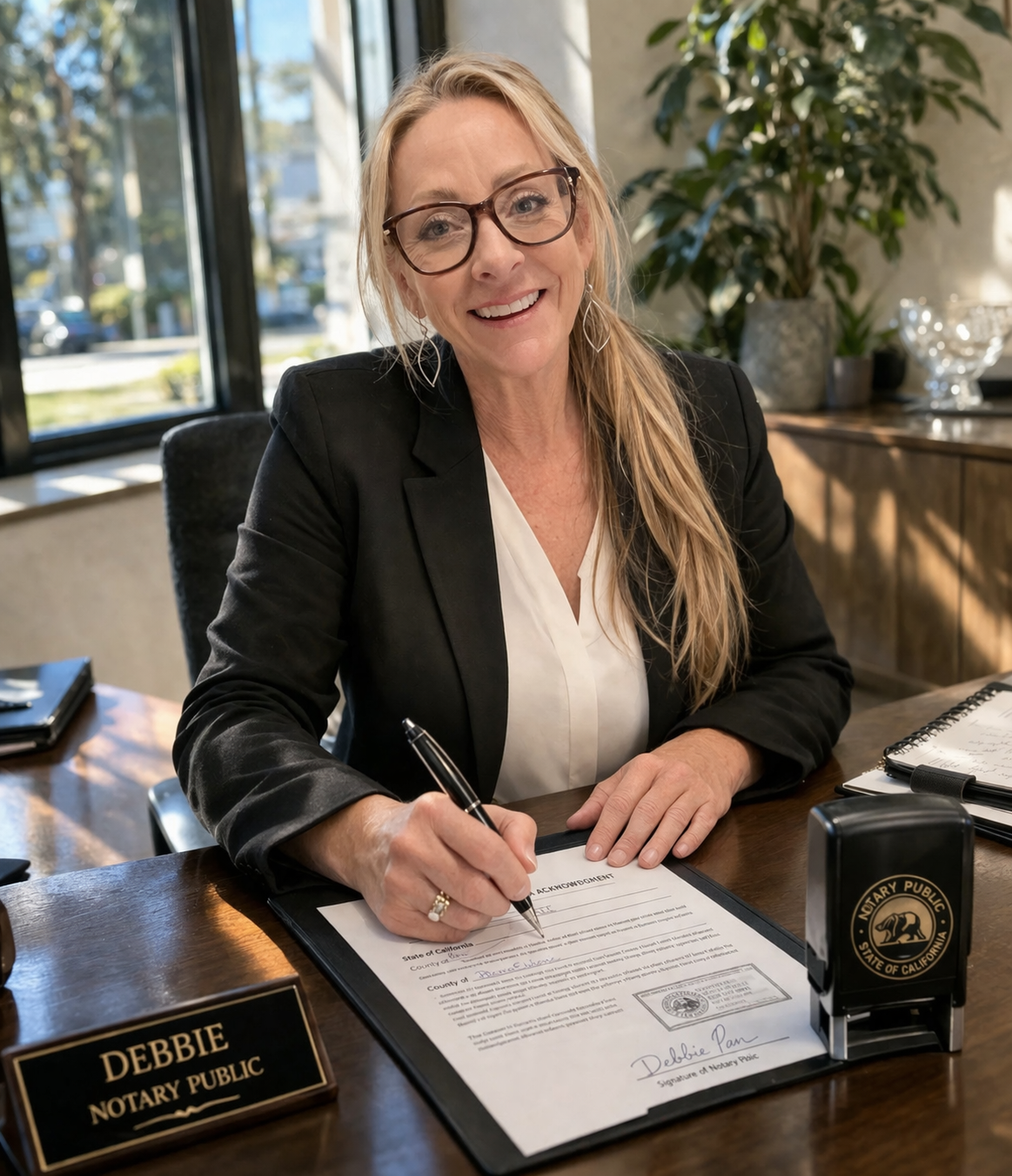
Deborah Cuha
Licensed Utah Notary Public (Commission #742886) with 30+ years of experience. NNA Certified Loan Signing Agent and Certified Remote Signing Agent. Based in Park City, serving Summit, Wasatch, and Salt Lake counties.
Read Full Bio →