Find the pages that have a notary block, leave them unsigned, and bring them with unexpired photo ID to a Utah notary. Here is how to read the signature area of each page, what the notary does and what it costs.
Go through your divorce papers, find each page that has a notary block near the signature line, and bring those pages unsigned with unexpired photo ID to a Utah notary. Many Utah court forms have no notary block at all, so check each page before you book.
Key Takeaways
- The wording printed by the signature line tells you whether a page goes to a notary. A notary cannot decide that for you (Utah Code 46-1-11).
- Two Utah State Courts forms opened for this article end with "I declare under criminal penalty under the law of Utah that everything stated in this document is true" and have no notary block.
- A third Utah court form opened for this article has a signature block for a "Court Clerk or Notary Public."
- A Utah notary cannot certify a copy of a divorce decree. Certified copies of court records come from the Clerk of Court.
- NotaryLTD charges $10 per notarial act in person and $25 per act by remote online notarization, plus an agreed travel fee for mobile visits.
Do divorce papers have to be notarized in Utah?
It depends on the page. Some pages in a Utah divorce carry a notary block and many do not. The wording printed by the signature line, the court and your attorney decide. A notary cannot tell you which of your papers need notarizing.
Three forms published by the Utah State Courts were opened for this article on November 19, 2026. They show both patterns. Forms are revised from time to time, so read the copy you were actually given.
| Utah court form opened | Revision date printed on it | What is printed at the signature | Notary block? |
|---|---|---|---|
| Stipulated Motion, form 1102GEJ | January 6, 2020 | "I declare under criminal penalty under the law of Utah that everything stated in this document is true." One block for each party | No |
| Financial Declaration, form 1352FAJ | November 21, 2022 | The same declaration under criminal penalty | No |
| Acceptance of Service, Appearance, Consent and Waiver | April 29, 2020 | A certification that the signer "voluntarily signed this document and declared that it is true," with a line for the printed name of a "Court Clerk or Notary Public" and a space for a notary seal | Yes, for a court clerk or a notary |
The declaration line on the first two forms tracks a Utah statute. Utah Code 78B-18a-104(1) says that where state law requires or permits a sworn declaration, an unsworn declaration that meets the chapter "has the same effect as a sworn declaration." Section 78B-18a-106 gives the form of words: "I declare under criminal penalty under the law of Utah that the foregoing is true and correct."
The same section lists what the chapter does not apply to, including "a deposition," "an oath of office" and "a declaration to be recorded under Title 57, Real Estate." Whether that statute covers a particular paper in your case is a question for the court or an attorney, not for a notary.
Papers that did not come from the court's own forms are a separate matter. A settlement agreement drafted by an attorney or mediator, a deed, a form from a retirement plan or a paper for a court in another state may each carry its own notary block. The Utah State Courts divorce page is the place to start for the court's own steps and forms.
How can I tell which pages need a notary?
Read the area around each signature line. A notary block has a place for the notary's signature and seal and wording such as "subscribed and sworn to before me" or "personally appeared." A page that ends with a declaration under criminal penalty and nothing else has no notary block.
Utah's own certificate wording is in Utah Code 46-1-6.5. The jurat form begins "Subscribed and sworn to before me." The acknowledgment form says the signer "personally appeared" and "acknowledged (he/she/they) executed the same." Use the table below to sort your stack. It describes what is on the page. It does not tell you what your case requires.
| What you see by the signature line | What it is | What to do |
|---|---|---|
| "I declare under criminal penalty under the law of Utah..." with a signature line and no seal area | An unsworn declaration. There is no notarial certificate on the page | Nothing for a notary to complete. If someone told you to notarize it anyway, ask that person which notarial act they want |
| A block for a "Court Clerk or Notary Public" | A certification that either official can complete | Leave it unsigned and bring it with your ID |
| "Subscribed and sworn to before me" | A jurat. You take an oath and sign in front of the notary | Do not sign ahead of time |
| "Personally appeared" and "acknowledged" | An acknowledgment. You tell the notary in person that you signed voluntarily | Bring it with your ID. Leaving it unsigned is the safe habit |
| A deed with a notary block | A document meant for the county recorder | Bring it unsigned. Recording questions go to the county recorder or whoever prepared the deed |
| A signature line with no declaration and no notary wording | Unclear from the page | Ask the party that will receive it. See what to do when a document has no notary wording |
On deeds: Utah Code 57-3-101(1) says a certificate of acknowledgment, proof of execution or jurat "entitles the document and the certificate to be recorded in the office of the recorder of the county where the real property is located."
What does the notary do with divorce papers?
The notary confirms your identity, performs the act the page calls for, completes the notarial certificate and applies the seal. For a jurat the notary also gives you an oath. The notary does not review the terms or approve the agreement.
Utah Code 46-1-2 defines an acknowledgment as a notarial act in which a notary certifies that a signer whose identity is known or proven "has admitted, in the presence of the notary, to voluntarily signing a document for the document's stated purpose." A jurat is different. The notary certifies "that the signer affirms or swears an oath attesting to the truthfulness of a document" and "that the signer voluntarily signs the document in the presence of the notary."
The oath for a jurat is set out in Utah Code 46-1-6.5(2)(a): "Do you swear or affirm under penalty of perjury that the statements in your document are true?" More on the two acts in the difference between a jurat and an acknowledgment.
Do both spouses have to see the notary together?
The Utah notary statutes quoted in this article do not require spouses to appear together. A notary certifies only the signature of a person who appears before the notary. Each spouse can book a separate appointment, and each signature gets its own notarial certificate.
Utah's acknowledgment form in Utah Code 46-1-6.5(3) names the signer who "personally appeared" before the notary on a stated date. A spouse who was not there is not covered by that certificate. If the two of you sign the same page on different days or with different notaries, the page ends up with two certificates. Ask whoever will receive the page whether that is acceptable to them before you plan it that way.
The notary also has to be a neutral party. Under Utah Code 46-1-7, a notary may not perform a notarial act if the notary "is a signer of the document that is to be notarized" or is named in it, with narrow exceptions. A relative with a commission who is named in your papers has to step aside.
What ID do I need to get divorce papers notarized?
Unexpired government identification that shows your photograph, signature and physical description, or an unexpired passport from any nation. A Utah driving privilege card is not accepted. Each person whose signature is notarized brings their own.
The rule is the definition of satisfactory evidence of identity in Utah Code 46-1-2. It covers "unexpired personal identification" issued by the United States government, a state, a federally recognized tribal government or a foreign government, and "an unexpired passport issued by any nation." The same definition excludes "a driving privilege card."
If you changed your name or are about to, compare the name printed on each page with the name on your ID before you book. If they differ, tell the notary when you call and ask the party that prepared the page how it should read. Details are in what ID a Utah notary accepts.
Should I sign my divorce papers before the appointment?
No. Leave every page that has a notary block unsigned until you are in front of the notary. A jurat requires you to sign in the notary's presence, and waiting means you never have to sign a page twice.
Fill in every blank you can before the visit, other than the signature and date by the notary block. Bring the whole document, not only the signature page. If you already signed, read can you notarize an already signed document and tell the notary when you book.
Can divorce papers be notarized online in Utah?
Utah law allows a commissioned remote notary located in Utah to notarize over live video. NotaryLTD offers remote online notarization at $25 per notarial act. Ask the court clerk or other receiving party whether it accepts an electronically notarized page before you choose this.
Utah Code 46-1-3.6(1) allows a remote notarization "if the remote notary is physically located in this state." Subsection (4) says "a remote notarization lawfully performed under this chapter satisfies any provision of state law" that requires an individual to appear in person before a notary. That is a statement about Utah law. A court or agency in another state or country sets its own rules for what it accepts. To set up a session, start at remote online notarization. The steps are in how remote online notarization works in Utah.
Can a notary certify a copy of my divorce decree?
No. A divorce decree is a court record, and a Utah notary's copy certification is for documents that are not public records. A certified copy of your decree comes from the clerk of the court that handled the case.
Utah's copy certification form in Utah Code 46-1-6.5(4) has the notary state that "to the best of my knowledge, the photocopied document is neither a public record nor a publicly recorded document." The Utah State Courts divorce page says "A certified copy of a court record is dated, signed, and stamped by the Clerk of Court."
If you need the decree for use in another country, the Utah Lieutenant Governor's authentication office says a divorce decree "must be a certified copy from the Court Clerk of the county where the divorce is recorded." That starts at the court, not at a notary. For the papers that do need a notary before an apostille, see apostille services.
Can the notary help me fill out the forms or tell me what to file?
No. A Utah notary who is not an attorney may not give advice about legal documents. The notary cannot pick your forms, explain what a term means, tell you whether an agreement is fair or say which notarial act a page should have.
Utah Code 46-1-11(1) reads: "A nonattorney notary may not provide advice or counsel to another person concerning legal documents" or legal proceedings. For help with the forms themselves, use the Utah State Courts divorce page linked above or talk to an attorney. See also can a notary give legal advice in Utah.
What the notary will do is perform the act for any person with a lawful request. Utah Code 46-1-8(2) says "A notary shall perform notarial acts in lawful transactions for any requesting person who tenders the appropriate fee specified in Section 46-1-12."
What does it cost to notarize divorce papers at NotaryLTD?
NotaryLTD charges $10 per notarial act in person and $25 per notarial act by remote online notarization. A mobile visit adds a travel fee based on the IRS mileage rate, agreed before the appointment. There is no travel fee at the Park City office.
Utah Code 46-1-12(1)(a) sets the most a notary may charge: "for an acknowledgment, $10 per signature" and "for a jurat, $10 per signature." For a remote notarization the maximum for the same items is $25. A travel fee is allowed only when the notary explains that it is separate from the notarial fee and both sides agree to it in advance.
| Line | How to count it | In person | Remote online |
|---|---|---|---|
| Notarized signatures | Count one for each person signing each page that has a notary block. Pages with only a declaration line count as zero | $10 each | $25 each |
| Travel | Mobile visits only. Quoted and agreed when you book | Based on the IRS mileage rate | None |
| Office visit in Park City | You come to 1090 Center Dr, Suite 23 | No travel fee | Not applicable |
A worked example, counted at the Utah maximum: one spouse signs a page with a jurat and a deed with an acknowledgment. That is two notarized signatures, or $20 in person before any travel fee. NotaryLTD confirms your total when you book. The full fee list is on the pricing page.
What should I bring, and how do I book?
Bring the complete unsigned pages that have a notary block and unexpired government photo ID. To book, call or text 435-565-1333 with the number of pages and signers and where you want to meet.
A checklist you can copy:
- Every page that has a notary block, complete and unsigned, with the rest of the document it belongs to.
- Unexpired government photo ID for each person signing.
- Your count of notarized signatures from the worksheet above.
- Any signing instructions from your attorney, mediator or the party that sent the paper.
- The name of the court or office that will receive each page, so you know who to ask if a question comes up at the table.
- Answers from the court's self-help resources or your attorney to any open question about the forms.
NotaryLTD meets you at the Park City office at 1090 Center Dr, Suite 23, Park City, UT 84098, or at your home, office, hospital room or care facility in Summit, Wasatch and Salt Lake counties. Appointments run Monday through Sunday, 9:00 AM to 9:00 PM, and same-day times are available. If you and your spouse would rather not sign at the same time, book two appointments.
- Contact NotaryLTD with the document type and the number of signatures. NotaryLTD confirms whether the office, a mobile visit or a remote session fits.
- Have your documents ready and unsigned.
- Present your ID.
- Sign in the notary's presence. The notary completes each certificate and applies the seal.
If you would rather write than call, send the page count and a preferred time through the contact form. Service details are on the general notarization and mobile notary pages. For a signing in the Salt Lake Valley, see the Salt Lake City service page.
Pages ready to sign?
Call or text NotaryLTD at 435-565-1333 to book an office or mobile appointment. $10 per notarial act in person. Open Monday through Sunday, 9:00 AM to 9:00 PM.
Call 435-565-1333This article is general information about Utah notarial acts, the statutes quoted above and three court forms as they read on the day they were opened. It is not legal advice. A notary is not an attorney and cannot tell you which divorce papers you need or whether any of them must be notarized. Ask the court, your attorney or the party that will receive the document.
Frequently Asked Questions
About the Author
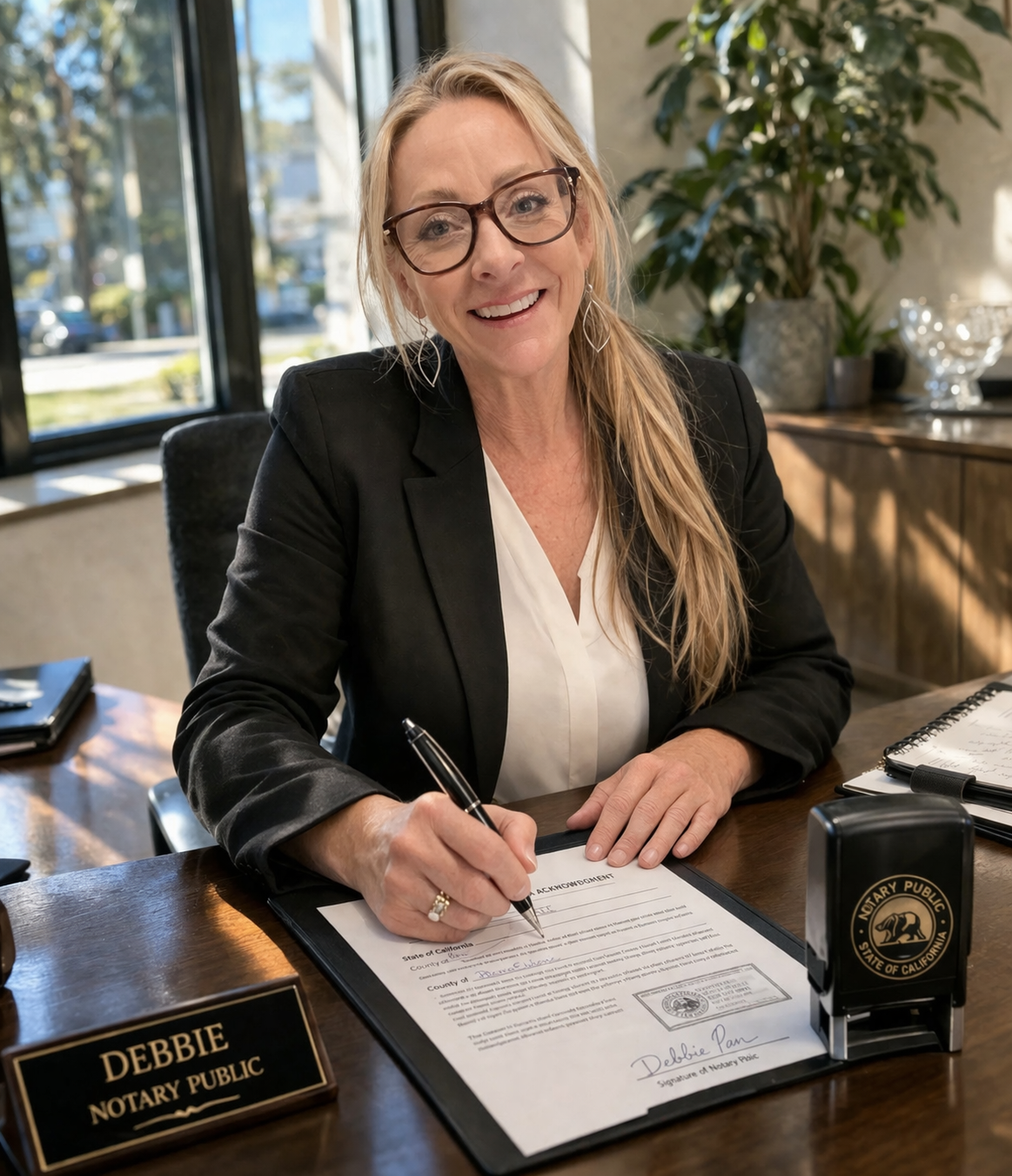
Deborah Cuha
Licensed Utah Notary Public (Commission #742886) with 30+ years of experience. NNA Certified Loan Signing Agent and Certified Remote Signing Agent. Based in Park City, serving Summit, Wasatch, and Salt Lake counties.
Read Full Bio →