Book a Utah notary, bring the complete unsigned trust and unexpired photo ID for every signer, and sign in front of the notary. Here is what Utah law says about trusts and notaries, what to check in your signing package and what it costs.
Book a Utah notary, bring the complete unsigned trust and unexpired photo ID for every signer, and sign in front of the notary. Utah's trust statute does not list a notary among the requirements for creating a trust, so whether yours is notarized is decided by whoever drafted it and by the parties that will rely on it.
Key Takeaways
- Utah Code 75B-2-402 lists five requirements for creating a trust. A notary is not one of them.
- A notarial certificate entitles a document to be recorded with the county recorder (Utah Code 57-3-101). Check any deed in your trust package for one.
- A Utah notary cannot notarize a trust that names the notary, for example as trustee or beneficiary (Utah Code 46-1-7).
- The notary checks identity and completes the certificate. The notary does not review, explain or approve the trust (Utah Code 46-1-11).
- NotaryLTD charges $10 per notarial act in person and $25 per act by remote online notarization, plus an agreed travel fee for mobile visits.
Does a living trust have to be notarized in Utah?
Utah's trust statute does not list notarization as a requirement for creating a trust. If your trust was drafted with a notary block under the signature lines, it is meant to be signed in front of a notary. The drafter decides what yours needs.
The requirements are in Utah Code 75B-2-402(1), which begins "A trust is created only if:" and then lists five things. The person creating the trust has the capacity to do it. That person indicates an intention to create it, or a statute or court order authorizes it. The trust has a definite beneficiary, with a few listed exceptions such as a charitable trust. The last two items read "the trustee has duties to perform" and "the same person is not the sole trustee and sole beneficiary." No notary or witness appears in the list.
Section 75B-2-407 of the same part goes further. It says "Except as required by a statute other than this chapter, a trust need not be evidenced by a trust instrument," and adds that an oral trust has to be proven by clear and convincing evidence.
That is what the statute says in general. It is not a statement about your trust. Other statutes can apply, and a bank, title company or county recorder can set its own requirements for the papers it accepts. A notary cannot tell you whether your trust needs to be notarized. Ask the attorney or service that prepared it.
Which documents in a trust package go to a notary?
Any document in the package that carries a notarial certificate. Look for a notary block under the signature lines. Check a deed first if you have one, because under Utah law a notarial certificate entitles a document to be recorded with the county.
Utah Code 57-3-101(1) says a certificate of acknowledgment, proof of execution or jurat "entitles the document and the certificate to be recorded in the office of the recorder of the county where the real property is located." Subsection (2) adds that notarial acts affecting real property in Utah must also follow the Notaries Public Reform Act.
Your package may also hold a certification of trust. Utah Code 75B-2-1013 lets a trustee hand that to a bank or title company in place of a copy of the whole trust, and subsection (4) says "A certification of trust need not contain the dispositive terms of a trust." Whether the party receiving it wants a notarial certificate on it is that party's call.
Not every package has all of the documents below. The table is a way to sort what you were given. It is not a list of what you need.
| If your package has this | Check this on the page before you book | Who to ask when it is unclear |
|---|---|---|
| Trust agreement or declaration of trust | Is there a notary block after the signature lines? Count the signature lines and note who signs each one | The attorney or service that drafted it |
| Certification of trust | Is there a notary block? Which trustees sign? | The bank, title company or other party that asked for it |
| Deed moving real estate into the trust | Is there a notary block? Is each name printed the way it appears on your ID? | The drafter, and the county recorder for recording questions |
| A will signed the same day | Witness lines, and any affidavit page that has a notary block | The drafter. Wills have their own witness rules |
| Power of attorney or health care directive signed the same day | Notary block, witness lines or both | The drafter |
| A signature page with no notary wording | Do not assume it gets a stamp. Ask which notarial act, if any, is wanted | The drafter. See what to do when a document has no notary wording |
Related reading: do wills need to be notarized in Utah and do I need a notary for a power of attorney in Utah.
What does the notary do at a trust signing?
The notary confirms each signer's identity, takes the acknowledgment or watches the signing, completes the notarial certificate and applies the seal. The notary does not read the trust for you, explain its terms or confirm that it does what you want.
When a document already has a notary block, its wording shows which notarial act is called for. Utah Code 46-1-2 defines an acknowledgment as a notarial act in which the notary certifies that a signer whose identity is known or proven "has admitted, in the presence of the notary, to voluntarily signing a document for the document's stated purpose."
The limit on the notary's role is in Utah Code 46-1-11(1): "A nonattorney notary may not provide advice or counsel to another person concerning legal documents or legal proceedings, including immigration matters." Questions about what the trust says, who should be trustee or what should go into it belong to your attorney. Have them answered before the appointment.
Can the notary be my trustee, or can a relative who is a notary do it?
Not if the notary is named in the trust. Utah law bars a notary from notarizing a document the notary signs or is named in. A notary who is your trustee, successor trustee or beneficiary has to step aside, and you need a different notary.
Utah Code 46-1-7 reads: "A notary may not perform a notarial act if the notary:" "(1) is a signer of the document that is to be notarized" or "(2) is named in the document that is to be notarized." The exceptions listed in that section are narrow. They cover self-proved wills, an attorney listed only as representing someone, and certain licensed escrow agents at a closing.
The same section also bars a notary who "will receive direct compensation from a real property transaction in which the notary is named individually as a grantor, grantee, mortgagor, mortgagee, trustor, trustee, beneficiary," or in a similar role. So before a friend or relative with a commission offers to help, check every page for that person's name. More on this in can a notary sign for a family member in Utah.
Who has to be at the appointment and what ID do they need?
Every person whose signature is being notarized appears before the notary with unexpired government photo ID. For two spouses signing one trust, that means both. If your drafter told you to bring witnesses, they come too.
Utah Code 46-1-2 defines satisfactory evidence of identity. It includes "unexpired personal identification" that "includes the individual's photograph, signature, and physical description" and is issued by the United States government, a state or territory, a federally recognized tribal government or a foreign government. It also includes "an unexpired passport issued by any nation." The same definition says satisfactory evidence "does not include" "a driving privilege card."
A signer with no qualifying ID can be identified by the oath of a credible individual under the same section. Raise that when you book, not at the table. Details are in what ID a Utah notary accepts.
Before you book, compare the name printed on each document with the name on your ID. If they differ, tell the drafter and the notary ahead of time.
Should I sign the trust before the appointment?
No. Bring every document unsigned. Some notarial acts require you to sign in the notary's presence, and waiting keeps all of them available. Bring every page, not only the signature pages.
Utah Code 46-1-2 defines a jurat as an act in which the signer swears or affirms the document is true and "voluntarily signs the document in the presence of the notary." A signature witnessing also requires signing "in the presence of the notary."
Can a trust be notarized online in Utah?
NotaryLTD offers remote online notarization at $25 per notarial act. You appear by secure video and your identity is checked a second way. Whether each party that will rely on the trust accepts an electronically signed and notarized document is that party's decision, so ask first.
For a remote notarization, Utah Code 46-1-2 requires "secondary authentication of identity" in addition to the identification described above. If your package includes a deed, ask the county recorder what it accepts before choosing a remote session. To set one up, start at remote online notarization. The process is laid out in how remote online notarization works in Utah.
What does it cost to notarize a trust at NotaryLTD?
NotaryLTD charges $10 per notarial act in person and $25 per notarial act by remote online notarization. A mobile visit adds a travel fee based on the IRS mileage rate, agreed before the appointment. There is no travel fee at the Park City office.
Utah Code 46-1-12(1) sets the maximum a notary may charge: "for an acknowledgment, $10 per signature" and "for a jurat, $10 per signature." For a remote notarization the maximum is $25. Subsection (2) allows a travel fee, "not to exceed the approved federal mileage rate," only if the notary explains that it "is separate from the notarial fee" and both sides "agree upon the travel fee in advance."
Use this worksheet to estimate the total before you call:
| Line | How to count it | In person | Remote online |
|---|---|---|---|
| Notarized signatures | Go document by document. Count one for each person signing a page that has a notary block | $10 each | $25 each |
| Travel | Mobile visits only. Quoted and agreed when you book | Based on the IRS mileage rate | None |
| Office visit in Park City | You come to 1090 Center Dr, Suite 23 | No travel fee | Not applicable |
A worked example, counted at the Utah maximum: two spouses each sign a trust and a deed, and both documents have an acknowledgment. That is four notarized signatures, or $40 in person before any travel fee. NotaryLTD confirms your total when you book. The full fee list is on the pricing page.
Where can NotaryLTD meet me for a trust signing?
At the Park City office, or at your home, office, hospital room or care facility. Mobile appointments cover Summit, Wasatch and Salt Lake counties. Appointments run Monday through Sunday, 9:00 AM to 9:00 PM, and same-day times are available.
The office is at 1090 Center Dr, Suite 23, Park City, UT 84098. For a signing in the Salt Lake Valley, see the Salt Lake City service page. For a signer who cannot travel, see mobile notary service and can a notary come to a hospital in Utah.
What should I bring to a trust signing?
Bring every page of every document, unsigned, plus unexpired government photo ID for each signer and the signing instructions from whoever drafted the trust. Bring witnesses only if the drafter told you to.
A checklist you can copy:
- All documents in the package, complete and unsigned.
- Unexpired government photo ID for every person signing.
- The drafter's signing instructions, if you were given any.
- Your count of notarized signatures from the worksheet above.
- The names of everyone named in the trust, so the notary can confirm before the visit that the notary is not one of them.
- Witnesses, if the drafter said the package needs them.
- Answers from your attorney to any open questions about the trust itself.
How do I book a trust signing with NotaryLTD?
Call or text 435-565-1333. Say which documents are in the package, how many people are signing and whether you want the Park City office, a mobile visit or a remote session. NotaryLTD notarizes what your attorney prepared and does not draft legal documents.
- Contact NotaryLTD with the document types, the number of signers and where you want to sign.
- Have the attorney-prepared documents ready and unsigned.
- At the signing, every signer presents valid ID, signs, and the notary completes each certificate.
- You leave with your notarized originals.
If you would rather write than call, send the document list and a preferred time through the contact form. Service details are on the estate planning notary page.
Trust package ready to sign?
Call or text NotaryLTD at 435-565-1333 to book an office or mobile signing. $10 per notarial act in person. Open Monday through Sunday, 9:00 AM to 9:00 PM.
Call 435-565-1333This article is general information about Utah notarial acts and the statutes quoted above. It is not legal advice. A notary is not an attorney and cannot tell you whether your trust needs to be notarized or which documents you need. Ask your attorney or the party that will receive the document.
Frequently Asked Questions
About the Author
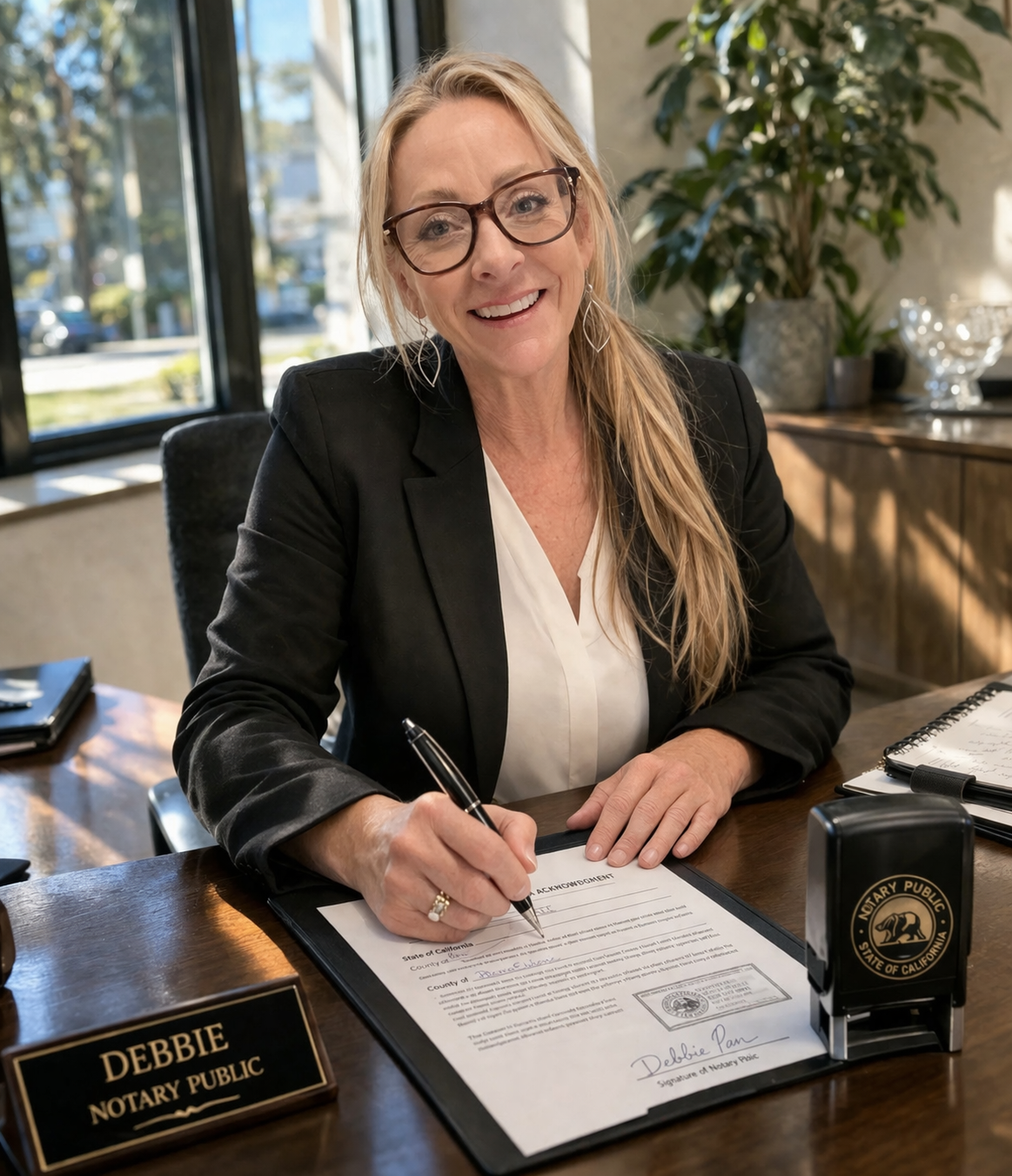
Deborah Cuha
Licensed Utah Notary Public (Commission #742886) with 30+ years of experience. NNA Certified Loan Signing Agent and Certified Remote Signing Agent. Based in Park City, serving Summit, Wasatch, and Salt Lake counties.
Read Full Bio →